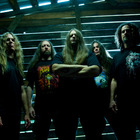
One of the highly-revered ‘big four’ of the thrash metal genre, alongside their contemporaries Metallica, Megadeth and Anthrax, Slayer have always been defined by two thing; the ferocity and speed with which they play, and the deeply dark nature of their thematic approach and lyricism, where pretty much nothing has been off limits - everything from Satanism to necrophilia has cropped up over the course of their ten records to date. The group is currently comprised of King on guitar, bass-playing frontman Tom Araya, drummer Paul Bostaph and guitarist Gary Holt; founding guitar player Hannemann passed away last year. The band made their name with their third album, “Reign in Blood”, in 1986; that record’s kind-of title track “Raining Blood” is effectively their signature song.
They’ve continued to both entertain, influence and provoke in equal measure ever since; from (albeit inadvertently) managing to release a record entitled “God Hates Us All” on September 11th, 2001 to routinely being accused of Nazi sympathies, Slayer have certainly earned more than their fair share of notoriety, but it’s perhaps in terms of their huge influence on the genre of metal in general that they’ll be best remembered over time; everybody from System of a Down to Slipknot to Darkthrone have attributed some of their style to Slayer over the years, proving their towering stature within the metal community.
The band took inspiration from thrash metal bands like Slayer and Kreator, as well as other death metal bands like Autopsy and Morbid Angel. The band is also highly influenced by horror movies, which can be conveyed by the band’s music. The band is known for their highly controversial album covers and lyrics, which has lead to them being banned from several countries. The band originally consisted of bassist Alex Webster, guitarists Jack Owen and Bob Rusay, vocalist Chris Barnes, and drummer Paul Mazurkiewicz. The band released their debut self-titled demo in 1989, which immediately caught the attention of Metal Blade Records, who signed the band.
Cannibal Corpse released their full-length debut album “Eaten Back to Life” in 1990. The album was presented in a thrash metal style that contained fast-paced, distorted guitar riffs, thumping double bass drums, and deep, growling vocals. In 1991 the band released the album “Butchered at Birth”, which solidified their signature death metal style. Chris Barnes’ growling vocals became deeper on this album, which would determine the sound of Cannibal Corpse’s next albums. The band’s third studio album “Tomb of the Mutilated” was released in 1992 and would become banned in Germany due to the intense nature of the album artwork and lyrics. The album was praised by critics and “Rock Hard” magazine ranked it No. 278 for “The 500 Greatest Rock & Metal Albums of All Time”. The album also contained the popular single “Hammer Smashed Face”, which also gained popularity due to its inclusion in the movie “Ace Ventura: Pet Detective”.
In 1993 guitarist Bob Rusay would leave the band and would be replaced by Rob Barrett. In 1994 the band released one of their most successful albums to date “The Bleeding”. The album was the band’s first album to place them on the Billboard charts. The album featured a more groove metal style as well as more technical guitar work. In 1995 vocalist Chris Barnes left the band and went on to form the band Six Feet Under. Barnes was replaced by George “Corpsegrinder” Fisher. The band released the album “Vile” in 1996, which made its way on the Billboard 200 chart. Pat O’Brien joined the band on guitars in 1998 and appeared on the album “Gallery of Suicide”.
The band’s ninth studio album “The Wretched Spawn” was the band’s last album to feature guitarist Jack Owen before he parted ways with the band. In 2006 the band released the album “Kill”, which featured the single “Make Them Suffer”. In 2009 the band released “Evisceration Plague”, which reached the No. 66 spot on the US Billboard 200 chart. The band’s increasing popularity would continue to show through 2012’s release “Torture” and 2014’s release “A Skeletal Domain”.
Prior to forming Crowbar, guitarist and vocalist Kirk Windstein joined the band Shell Shock alongside drummer Jimmy Bower. When the band’s guitarist Mike Hatch committed suicide, Windstein and Bower carried the band on as Aftershock and experimented with a more doom metal sound. After a series of name and personnel changes, by mid 1991 the band was renamed Crowbar with a line-up consisting of Windstein, bassist Todd Strange, drummer Craig Nunenmacher, and lead guitarist Kevin Noonan.
Crowbar’s debut came in 1992 with the album “Obedience Through Suffering” and signed with Pavement Music. Crowbar’s subsequent self-titled album in 1993 and “Time Heals Nothing” in 1995, were issued by the new label, the former of which earned national promotion on MTV’s Headbanger’s Ball. After the release of “Time Heals Nothing” Nunenmacher left the group, and was replaced by Jimmy Bower for the albums “Broken Glass” in 1996 and “Odd Fellows Rest” in 1998. Choosing to focus on his other project Eyehategod, Bower left shortly after and was replaced by Sid Montz who recorded drums on 2000’s “Equilibrium”.
In 2001 with a line-up consisting of Windstein, Sammy Duet on lead guitar, Jeff Okoneski on bass, and Tony Constanza on drums, Crowbar released their seventh studio album “Sonic Excess in its Purest Form” on Spitfire Records. The band supported the album with an extensive touring schedule, and with Crowbar plagued with tumultuous line-up changes, often members of other bands needed to fill in. The band has subsequently released the albums “Lifesblood for the Downtrodden” in 2005, “Sever the Wicked Hand” in 2011, and “Symmetry in Black” in 2014.
Slayer is frighteningly intense live. You could either get your skull cracked open in a mosh pit or from the sheer amplitude of Kerry King’s guitar. But that’s the thrill of attending a Slayer concert.
It is impossible to be anything other than fully engaged at a Slayer show with red lights of doom blaring on the stage, pentagrams and World War II imagery depicted in the background, and stacks of guitar amps blaring in your face at full volume all while trying to avoid getting beat to a pulp in a mosh pit. Slayer’s performance is fast and loud with their songs relying on fast tremolo picking, booming double bass pedals pounding away at the bass drums, and dueling guitars playing chaotic melodies in irregular scales creating dissonant sounds.
Slayer has a unique style of performing by playing at rapidly fast tempos and tuning their guitars to very low pitches getting deeper, heavier sounds. Slayer has gained critical acclaim already being nominated for five grammys, and are considered one of the most influential metal bands having directly inspired the genres of death metal and black metal. The singer, Tom Araya, adds much charisma to Slayer’s style with his death-like screams, and the violent imagery depicted in Slayer’s lyrics puts Slayer in a hardcore level of their own.
It is unpredictable what one might see at a Slayer concert. You might see a fan carving an upside down cross in their skin or you might see someone in a wheelchair crowd surfing, as I saw at my first Slayer concert. One thing you can predict is a mind-blowing thrill of a ride.
What’s in a name? Just the other day, I was remarking to a friend that Guardians of the Galaxy, just from the title alone, didn’t sound like the sort of film I’d be interested in; similarly, I can’t really imagine that Radio 3 listeners will be rushing out to procure the entire Cannibal Corpse discography any time soon. Just in case that wasn’t enough, though, they apply the sensibility to their song titles - ‘Hammer Smashed Face’ and ‘Skewered from Eye to Eye’ actually being among the less offensive - and themselves, with frontman George Fisher better known as Corpsegrinder, although presumably not to his mother. Nevertheless, Cannibal Corpse remain one of the great examples of the cult metal band, and retain a strong fanbase both in the UK and overseas; they’re not afraid to mix things up, either, touring with Children of Bodom back in 2009 despite the possibility of a clash in audiences. Needless to say, first time Corpse attendees should expect brutal noise levels, high technical proficiency, and a barrage of outrageous lyricism from Corpsegrinder that only those with the steeliest of nerves would consider to be anything less than a bit much; if mosh pits are your thing, though, the venue floors tend to pretty much be converted into one giant one throughout, so there’s that, at least.
I’ve been to many metal shows, and listen to a lot of music in the genre, but Crowbar are the only sludge metal band I follow, and I know that some people are put off the slow pace of some of the tracks, but the way that the band intertwine their sound with the fast paced hardcore punk sections keeps it fresh and exciting. When I saw Crowbar perform most recently, it was just after the addition of Jeff Golden on bass, and he totally rocked it, and the entire band looked like they’d been playing together since their beginnings in the early 90s.
One of the tings that stands out for me every time I see them perform live, is the way that they command the stage. Although they’re often facing away from the audience to play their music to each other, the way that they jump and throw themselves around the stage is electric and massively contagious, and had everyone dancing from start to finish.
They opened their set with Self-Inflicted, which had everyone singing along right away, and getting really into the music. They played a great combination of their old and newer material, catering for all the fans there. The show was nearly 2 hours long, and I don’t think the band stopped for a breather once, switching between epic solos and playing awesome tight sets together, but their energy didn’t drop once. For their finale, they played a mash up of some of their hits, and it was mind blowing. They were shouting out to us in the audience, and it was great to be so involved with the end of the show.